Tuesday, June 6, 2017

Longevity


The cemetery in Vourliotes is very small.  I think I counted only about 50 marked graves in it last year.  The custom here is to bury the dead under a small marble crypt.  After 5 years the body is exhumed by the family, the bones are carefully washed and transferred to a small box then stored in an ossuary for as long as there are family members around to care for them.
 
I started looking at the dates on those crypts and noticed that there were 3 women in the cemetery whose average age  was 100.  If half the people in the cemetery were women, then 3 in 25 of the women in the cemetery, or 12% of the women buried in that cemetery in the past five years, lived to be 100.  My math skills aren't the best, but that is an astonishing number.


Friday, June 2, 2017


Touching Down on Samos June 1, 2017


Kathy surprised Giannis with a few of these patches
  she'd made for him on her new sewing machine, just
 a day or two before leaving the States for Samos.

Landing on Samos this year was sweet indeed after more than 24 hours of travel time since leaving Mayport.  Giannis was waiting at the airport for us with a rental car, and all was right with the world again.
  
I've become more eager to get back to Samos every year, but have also come to dread the process of getting there.  This year we flew Delta.  They had oversold several seats on the flight from Jacksonville to Kennedy flight, and had oversold the flight from Kennedy to Athens by 6 seats.  Travelers can forget their manners in boarding lines, even with sequenced boarding sections, but waiting in the boarding line for Athens, felt like waiting to board the last American helicopter to leave Saigon.

One year we got back to find that the water had been shut off.  This year the electricity was off, but the thick stone walls had insulated the house which felt like an air conditioner had been on while we'd been gone.  A couple of cold showers, a change into a clean set of clothes, and we walked up to the Blue Chairs Restaurant for a Greek salad and a couple bottles of cold beer.

Monday, May 15, 2017

Coffee with Neighbors


For past five seasons, we have been having evening conversations with a couple in the neighborhood who speak no English.  Whenever we are out in the alley grilling, eating or playing cards, they always stop and make polite chit-chat about food, the weather, or invite us to upcoming religious celebrations and events in the neighborhood.  They will often drop off a plastic bag full of produce from their garden, or sometimes they bring by a bottle of their homemade wine.  I have also encountered them further up the mountain gathering fresh herbs for making tea or cooking.  Until today we didn't even know their names.
 
The couple invited us to their house for coffee this morning, and to help with the language, Susan Trovas (a seasonal neighbor) came along as an interpreter.  In the shade of an orange tree above their stone grotto, we were treated to traditional small cups of dense Greek coffee, bakery cookies, and small cheese pastries our hostess had just baked.


Rena and Zephonos are a retired couple from Athens.  Zephonos grew up in Vourliotes, and Rena is from near Corfu.  They are seasonal residents of the village now, with a large garden/orchard behind their small stone home, and a vineyard up by the monastery from which Rena makes her wine.  Zephonos was an actor and chorus singer in outdoor theater productions, and owned a magic shop in Athens.  During coffee, Zephonos entertained us with an impromptu magic show and gave us a tour of the house and garden.  The house faces the village but the garden is a big agricultural plot with airy and unobstructed view of the Aegean Sea, below.  What an unexpectedly great morning!


Zephanos, Kathy, Susan, and Rena

*I just found this post, in draft form, as scheduled to have been posted exactly a year ago today (5/15/2016).  So better late than never, here it is.

Monday, July 11, 2016

Festival of St. John of the Fire, 2016

Fire jumping - photo by Newell

photo by Newell
There are villages on Samos like Vourliotes, were ancient pagan folk customs are still a recognizable part of the Festival of St. John of the Fire.  The festival is usually held on a Sunday night in late June and features music, food, wine, folk dancing, and the curious ritual of village children jumping over bonfires made from the dried floral wreaths that have been decorating local doorways since May Day (the first day of Summer). The festival is also called the Feast St. John's Eve and is usually followed by a Greek national holiday on Monday.  The Village festival and the official state holiday seem to be connected, but both events go by several different names, and even the Greeks seem a little vague about origin and meaning of the two events.


photo by Newell


photo by Newell
St. John's Nativity Day is celebrated near the Summer Solstice.  It celebrates the birthday of Christ's cousin, John the Baptist.  In Greece he is called St. John the Forerunner, who foretold the coming of Christ the Messiah.  The historic dates for John and Christ's birthdays have been lost, but by the 4th Century, a proto Christ Mass was being celebrated near the Winter Solstice to compete with the pagan Yule festivities.  According to the Gospel of Luke, John the Baptist was born six months earlier than Christ. which made St. John's Nativity Day a perfect fit to co-opt the pagan festival of Midsummer's Eve.  In Vourliotes, the Feast of St. John of the Fire has retained the pre Christian, pagan traditions of feasting, drinking, folk dancing, and leaping over bonfires made from the dried May Day wreathes.  A lawyer in Karlovassi offered that the St. John of the Fire Festival may have also once had a connection to classical times when Prometheus was honored for stealing fire from the gods and giving it to Man.  But that's another research project, and I know what Prometheus got for his trouble.
photo by Newell

For different earlier postings on the same event (2012 and 2013) see:
http://mysamoshome.blogspot.gr/2013/06/folk-dancing.html
http://mysamoshome.blogspot.gr/2012/06/village-festival.html  

Monday, May 30, 2016

Hike to Kokkari

 
With the Euro value down and gas prices low, you would expect this to be a good year for travel; but news of the refugees flooding into the Greek islands near Turkey last year has resulted in a 45 percent drop in tourism for those islands.  With Greek pensions cut in half and with taxes to double this year, the result has been devastating, especially for coastal towns like Kokkari who live or die by the tourist trade.  The irony is that the refugees are now being routed into Western Europe through Italy.  The nightly invasions of the beaches here have stopped and the holding camps are empty, but this year Western news is all about the election.

From the eastern rim of the village you can look down the mountain and see the coastal outline of Kokkari.  In seasons past, we were used to seeing Dutch tourists, or the flinty German hikers eating lunch in the Plataea.  They'd often drive or hike up the mountain from Kokkari in the morning, stop in Vourliotes for lunch, then hike on to Manolates, or walk back down the mountain for a swim in the Aegean.  This year Kathy wanted to hike down the mountain, have lunch and a drink in Kokkari, then catch the bus back to Vourliotes.  Down the mountain sounded easy enough, so I agreed.


Crossing a brook
When Kathy retired last year, she joined a gym and went almost daily to walk on their treadmills and swim in their pool.  When I retired it meant that the dog and I had more time to spend together in the golf cart or the recliner.  The scenery on today's hike was beautiful, but the soreness in my back and legs has been a painful reminder that the recliner and the channel changer have not been my friends.


Monday, May 2, 2016

Easter Weekend on Samos (part 2) - Saturday, Sunday

photo by Newell

Saturday

photo by Newell
Maruyo, a neighbor in her late eighties or early nineties placed a neat little stack of olive wood and a bag of charcoal by my outdoor grill, and brought Kathy a bowl full of little sour cherries as ‘welcome back’ gifts.

Later that morning, we drove to Samos Town to pick up a few supplies and have our Wi-Fi reconnected.  Coming down the mountain road we spotted a feral peacock.


A whole goat on the scale (head in plastic bag) -  photo by Newell
There was more activity in town than we had expected.  Roasted goat or lamb is to Greek Easter what roasted turkey is to an American Thanksgiving.  The butcher shop was packed like I’d never seen it before.  People were three deep at the counter, with a line out into the street.  Many of the customers were buying whole carcasses with the heads and tails still attached.

There was another night service at the Orthodox Church that ends at midnight with the symbolic ascension of Christ from the tomb.  Everyone leaves the church carrying a lit candle, and boys in the street setting off fireworks like it was New Year’s Eve.

Easter Sunday


photo by Newell
There was the formal indoor service at 11:00 AM followed by an outdoor pageant, liturgy, and reception in the Platea.  Pappa Kosta passed out bright-red dyed Easter eggs to the faithful, then brought two eggs by the house for Kathy who’d ‘played hookey’ from the service.
Sunday evening Kathy and I hiked up the mountain to the Vronta Monastery where we bumped into a neighbor who had us over for coffee.  It was after dark when we got home.


Click here for an older post on the Vrona Monastery  http://mysamoshome.blogspot.gr/2013/07/evening-walks-to-vronta-monestary.html

Sunday, May 1, 2016

Easter Weekend on Samos Greece - Good Friday


Good Friday in Vourliotes, 2016
photo by Newell
Easter weekend is a very big holiday in Greece.  Many businesses close from Saturday through Wednesday for the celebration.  Because of differences in the Julian and the Gregorian Calendars, Orthodox Easter fell on May first this year.  We had booked our plane tickets months ago, so the holiday was an unexpected bonus to our trip.
We touched down on Samos in the afternoon of Good Friday.  It was in the morning of Good Friday that Christ and the two thieves were crucified.  In deference to the Jewish holiday, the Romans hastened those executions so the bodies could be removed from the crosses and buried by sundown on the eve of the Sabbath (Saturday) and the first day of Passover.

Vourliotes' Own Papa Kostas
photo by Newell
At sunset, the church bells in our village began the call to worship, and a short time later we could hear the priest singing the Orthodox service from our house.  This was the first of several progressive services and a pageant to commemorate the death of Christ.  The whole village turned out for the event.  Each church or monastery has a special canopy or epitaphio that is intricately decorated with fresh flowers.  The flowered canopy represents the body and spirit of Christ.  After the first service it was carried in progress through the village and out to the cemetery, where the body of Christ is symbolically buried among the departed villagers.  The procession then moved to the Platea (village square) where a another was sung by the priest, who showered the crowd of bystanders with fresh flower petals.  The pageant ended back at church where the celebrants passed under the floral ‘epitaph’ and were sprinkled with cologne water.  There may have been still another service, but I had to leave.

Flower decorated Epitaphio - center
photo by Newell
 
By the end of the night I was exhausted.  We had just finished a 24-hour travel day and I had stood or walked another 3 hours during the procession.  When I finally crawled into bed, my last conscious thoughts were of the generations of our neighbors who had been and might be, reenacting that same pageant for centuries to come.  I also thought about the mortal remains of villagers who lie buried under their marble crypts, facing the East, patiently waiting for the dawn of their own resurrections. There is an aura of peaceful continuity and permanence about this place that I miss when I'm back in the States.


The Vourliotes Cemetery at night
photo by Newell
 

Thursday, August 6, 2015

Refugees: The Growing Cloud Over Samos

by Alec Newell
 
Greek official with refugees in Pythagorio, Samos - photo by Newell

The road between Avlakia and Vathi
photo by Newell
Until this year, one of the best things about being on Samos had been a vacation from the US daily news and the angst that always seemed to accompany it.  This season we have been bombarded with news from the folks back home about how bad the economy is here.  We were seeing it all first hand and probably had a better read on how things were than the information we were getting from all the third hand Email sources.  Greece has been having money problems for decades.  No news in that.


Refugees in Pythagorio - photo by Newell
What has really gotten our attention this year hasn't been the Greek economy so much as the hundreds of refugees who have been pouring ashore at night, leaving the beaches littered with scuttled life rafts, discarded clothing, empty plastic water jugs,  inner tubes, and orange life jackets.  Yesterday, almost as comic relief to the situation, I noticed a group of Greek boys swimming behind the seawall at Agios Konstantinos, playing with inner tubes, life vests, and an inflatable raft they'd salvaged from the beach.  Greek Huck Finns on the Aegean.

Greek boys playing in Agios Konstantios - photo by Newell
 
Pythagorio - photo by Newell 
The word from the locals is that these people are fleeing from Syria, Afghanistan, Iraq, and Somalia.  Most of them are passing through Turkey to escape the slaughter of Christians and the forced conscription of military aged men into groups like ISIS and the Taliban.  We have heard that Turkish coyotes are charging $1500.00 per adult and $800.00 per child, or about $30,000.00 per trip to tow a boat load of refugees to within a short distance of Samian beaches, then dumping them.  By morning there seem to be small groups of wet refugees and floating debris everywhere.

People who have been coming to Samos for twenty years now, say that there is no precedent for what we are seeing this season.  Web sources estimate that in the first five months of 2015 alone, more than 42,000 illegal "immigrants" have come ashore on Greek islands, or six times the total number that were estimated for all if 2014.  Given all the noisy press Greece has been getting about their economy, we thought it odd that there had been so little in the news about the refugees


Refugees in Pythagorio - photo by Newell
 

Tuesday, August 4, 2015

Patmos and the Book of Revelation

by Alec Newell
 Monastery of St. John the Theologian - photo by Newell

 
Entrance to the Cave of the Apocolypse
photo by Kristin Brodt
Yesterday I made a day trip to the neighboring island of Patmos with Kristin Brodt, a friend just in from Florida.  Patmos is just two hours south and west of Samos by ferry.  A smaller, drier Island than Samos, its main claim to fame is that it is where the Book of Revelation was written by John the Apostle while in exile from Ephesus during a period of Christian persecution under the Roman Emperor Domitian (reigned: 81 to 96 ad).

John's eighteen month stay on Patmos is fairly well documented, and the island has become a destination for tourists and pilgrims who come there to visit the monastery built in 1088, and to see the cave where the Book of Revelation was written. There is a natural stone niche and writing stand in the cave where the book was dictated from God's lips to John's ears, and faithfully recorded:

photo by Newell


Book of Revelation 1:11 - God to John the Apostle: I am Alpha and Omega, the first and the last: and, What thou seest, write in a book, and send it unto the seven churches which are in Asia; unto Ephesus, and unto Smyrna, and unto Pergamos, and unto Thyatira, and unto Sardis, and unto Philadelphia, and unto Laodicea.


Tour guided lunch at a large open air restaurant
photo by Newell
 
The monastery has miraculously escaped major looting over the centuries and still has a vast trove of important original icons, relics, and one of the best collections of Biblical manuscripts anywhere outside the Vatican.  There is a manuscript that is believed to be the oldest extant copy of the Gospel according to Mark, and an original rendering of an icon by El Greco on display in the museum.  The excursion took a full day and included a guided tour to the cave, museum, and monastery, a walking tour of Chora, a 16th  Century community built just outside the monastery, lunch at a nice open air restaurant, and a guided bus tour of the south end of the island.
 
 
The waiters who entertained us with traditional Greek dancing
photo by Newell

 
The restaurant is a family operated business where the mother and uncles still do the cooking and the waiters are all brothers and nephews who dress in traditional garb and perform authentic Patmian dances for their guests.  Patmos is a little off the beaten path for most tourists  and picture taking is not allowed inside the monastery church, the museum, or inside the Cave of the Apocalypse, but the experience is worth the trip if you have the time to visit the island.


Sporty little convertible at the port of Skala, Patmos
photo by Newell


Monday, July 20, 2015

A Traditional Greek Village Wedding

by Alec Newell 
 
The receiving line - photos by Newell
 
A typical wedding picture from a home in the village

I don't think I've been in a single home in the village that didn't have at least one traditional wedding picture hanging from its plastered walls.  Greek weddings like the Irish wakes have evolved into national stereotypes, so when we got the word that there would be a wedding in the village, I didn't want to miss it. 

 
Father of the bride

Our house stands about half way between the Orthodox Church where the wedding would be and the village plateia or town square where the banquet and reception was to be held afterward, so even without an invitation, I'd be able to see everything but ceremony itself.  The people in the wedding party:  the couple, the parents, the in-laws, bride's maids, flower girls, and even the Orthodox priest, all looked like they could have just stepped out of central casting for a Hollywood movie.  I'd heard from neighbors that the bride was Greek and that the Groom's accent sounded "British," but that wasn't enough information for a story. I needed to know more.  Their story turned out to be better than fiction.


Flower girls
I discovered that the groom was Welsh and the bride was indeed Greek with maternal family ties to the village going back at least four generations.  The bride's ancestral home, built by her great grandfather, is only six meters or less than twenty feet from the church where her grandmother and aunt had been married.  The bride, from about the age of thirteen, had always expressed an interest in being married in that same church one day.

I arranged a visit with the bride's mother, an aunt and the grandmother, to find out more about the people in the wedding and the family.  Over traditional Greek coffee and cookies from the bakery, I was treated to the whole family history.  It was an interesting and complex tale that closely parallels the national saga in which successive generations of young Greeks have left the country to seek opportunities an foreign countries, only to be drawn back at critical junctures of their lives to reconnect with family members and the villages which have been the cultural taproot that still anchors them to their Greek heritage.

The ancestral home and family portrait
The bride's great grandfather had been a Greek national who had gone to America early in the 20th Century, and had found work there as a lumber jack.  After losing a leg in a logging accident, he returned to Greece, married a girl who had been born here in Vourliotes, and had added a second story to the house where we were having coffee.

The bride's grandmother had met her husband near the village well in the days before the house had been piped for running water.  He was a young soldier from Athens, doing his military service on Samos.  To keep their meetings discreet, she would hang a white towel in an upstairs window of that house to signal the young soldier that she was on her way to the well.  In time the young soldier and his bride left the village for Cardiff, Wales where he found work as a ship's chandler servicing Greek merchant vessels engaged in the Welsh coaling trade.

The village's most recent bride was that ship chandler's granddaughter.  She was born and grew up in the UK, but made frequent summer visits back to their grandmother's house in Vourliotes.  That house is still in the family.  As a youngster, the girl would return home from her summer vacations speaking Greek and dreaming of her own wedding in the old church.  This week's wedding was the culmination of a single dream shared by three generations of women from the same family who had all worked hard to make that vision come true.  
 
The bride and groom
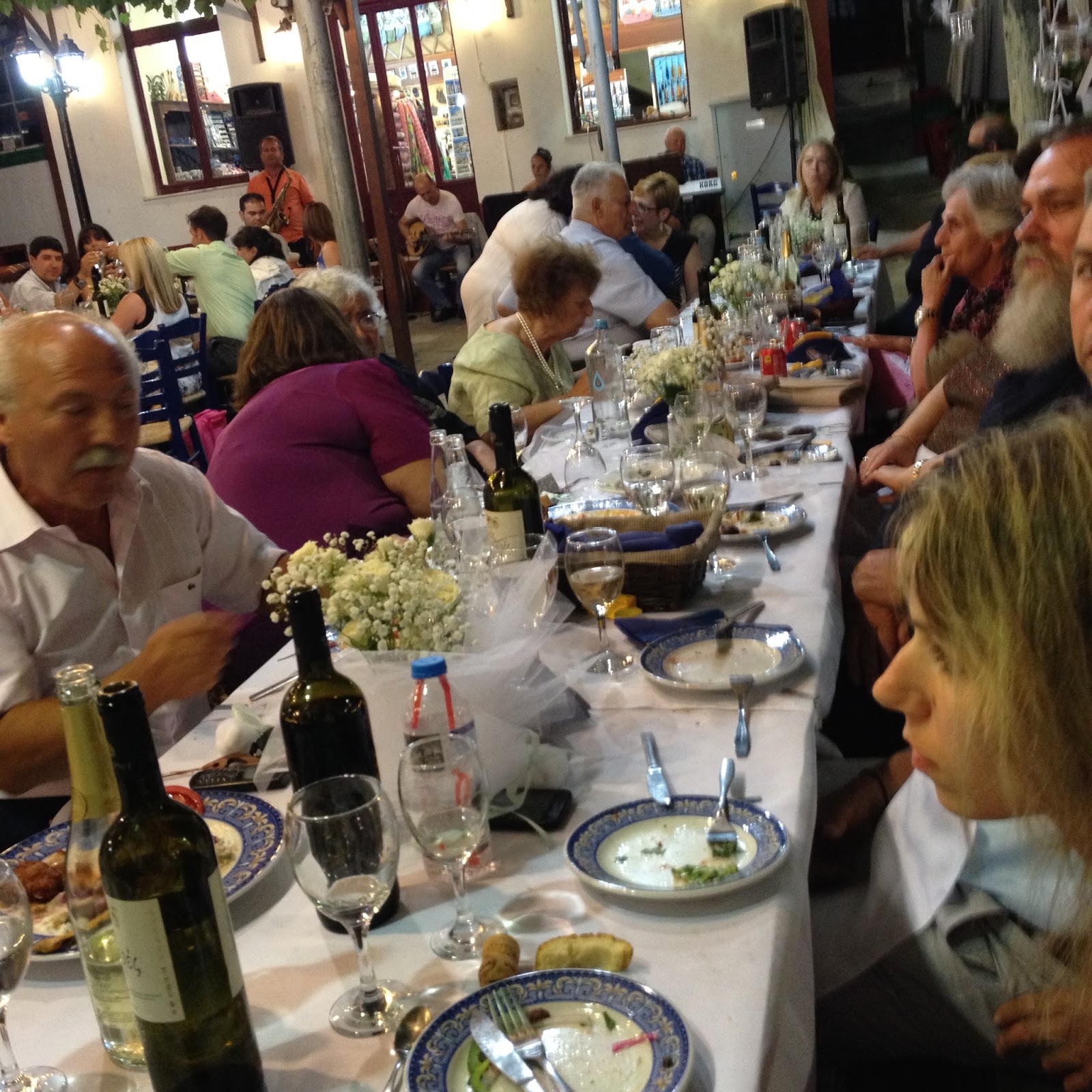
Reception banquet


The wedding with its large communal outdoor reception: the large seated banquet, the live music, drinking and dancing were traditions that seemed to breathe a renewed excitement into an aging village.  It was everything I had imagined that a traditional Greek wedding could be, and more.


The bride's maternal grandparents


Talking with the bride's grandmother, I learned an interesting sidebar to this story.  When I asked to see the picture from her own wedding, she told me that the photographer who had taken the picture had also made a blow-up of it as a window display for his studio. The enlarged photo was such a novelty at the time, that it actually drew small crowds on the sidewalk.  When the young couple saw it, they offered to buy the enlargement for themselves, but couldn't afford the price the photographer was asking for it.  The picture shown above went with them to Cardiff, the blow-up stayed behind on Samos, and has been lost to time.

For background information on this post read: "The Greek Diaspora" - 7/1/2013
at:  http://mysamoshome.blogspot.gr/2013/07/the-greek-diaspora.html

Sunday, July 12, 2015

Rebetiko Music at Bacchus' Taverna

"Bacchus' Traditional Taverna"
 
 Rebetiko Music
or
 "Greek Oldies" night at Bacchus' Tavern
 
by Alec Newell


The group called Tekeros - photos by Newell and Skaggs
Last night we received a word of mouth invitation to join some neighbors for dinner at a taverna in the upper end of the village that specializes in traditional Greek food and hot baked bread, all prepared on site from meat and vegetables produced by the family on a local plot of their own land.  In addition to the amazing food and local wine, the family had arranged for a quintet of young musicians who specialize in playing a style of Greek music called Rebetiko.


photo from the net
Rebetiko Music it turns out, is a form of urban folk music with complicated roots and traditions that officially dates from the 1920s to the 1950s.  There was a revival of the style beginning in about 1960 that continues today.  There were perhaps only thirty guests in the restaurant, which was a shame because the food and music should have rated a packed house anywhere on Planet Earth.


authentic Greek menu
The up side for us as Americans, was that we had had the incredible good luck to have been invited to such a small and intimate gathering.  As the evening progressed and younger guests trickled in, dishes were emptied and glasses were filled; wine flowed and the guests got mellow, the musicians loosened up and the music only got better.  A few members of the audience, their eyes glistening with wine and nostalgia, joined in the singing. Kathy and I of course, were unfamiliar with the lyrics, but music evokes universal emotions; laughter from the musicians and smiles from other guests drew us in and made us feel right at home.  Except for the Christmas holidays, it's something we rarely experience in our own culture these days.


Applause
It was already a very late night when Kathy and I left, but the musicians and younger guests seemed to still be gathering momentum as we started down the steps of the taverna to head home.  The owner followed us out and in very limited English, took our hands and let us know that he had been pleased to have had us as his guests, and hoped that we had enjoyed ourselves.  We stumbled back down the stone paved foot path toward the house in an almost giddy glow as the music trailed off behind us.  Nice party.

The table carnage left in our wake.